 edWebLab
Service · 3D & interactive
3D website design that still loads fast
Real-time WebGL scenes, built by hand with Three.js: a product that turns as you scroll, a brand that assembles from particles, a gallery you fly through. Designed around your brand — with a first version in days, not months.
What a 3D website can do for you
A 3D website is not a gimmick when it has a job. It can explain a product faster than a photo, make a brand feel physical, or turn a list of projects into something people actually explore. Everything on this site is built that way — scroll the home page to see it.
Scroll-driven stories
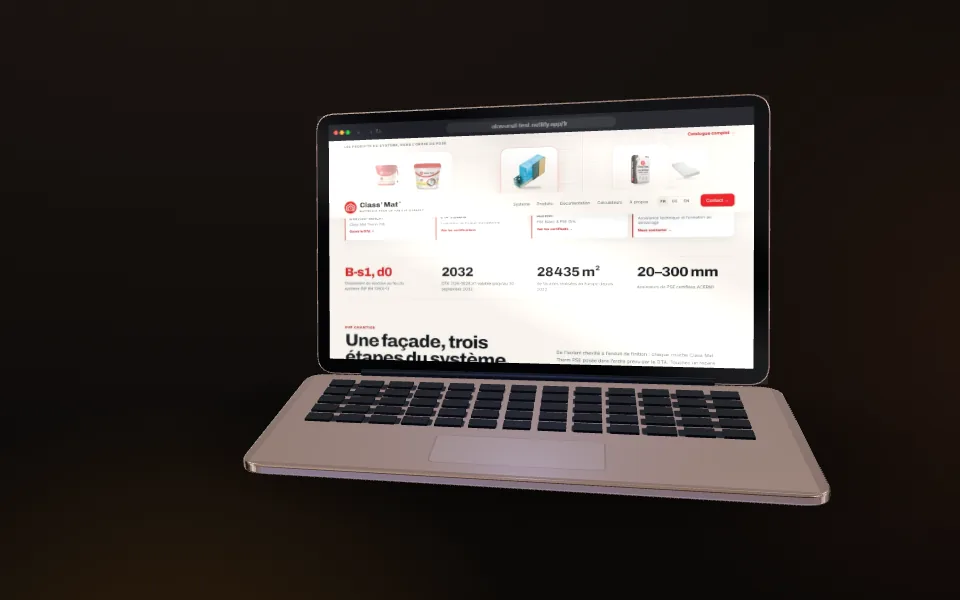
The page moves with the reader. Objects assemble, dissolve and change as you scroll — the laptop at the top of this site breaks into particles and rebuilds itself as a logo, a phone and a globe.
Your product in 3D
A product that turns, opens or explains itself on screen. Useful wherever a flat photo is not enough: building systems, materials, devices, anything with layers.
Immersive galleries
Instead of a grid of thumbnails, visitors move through your work. The Work section on this site is a camera flight through twelve project screens you can open live.
Brand in motion
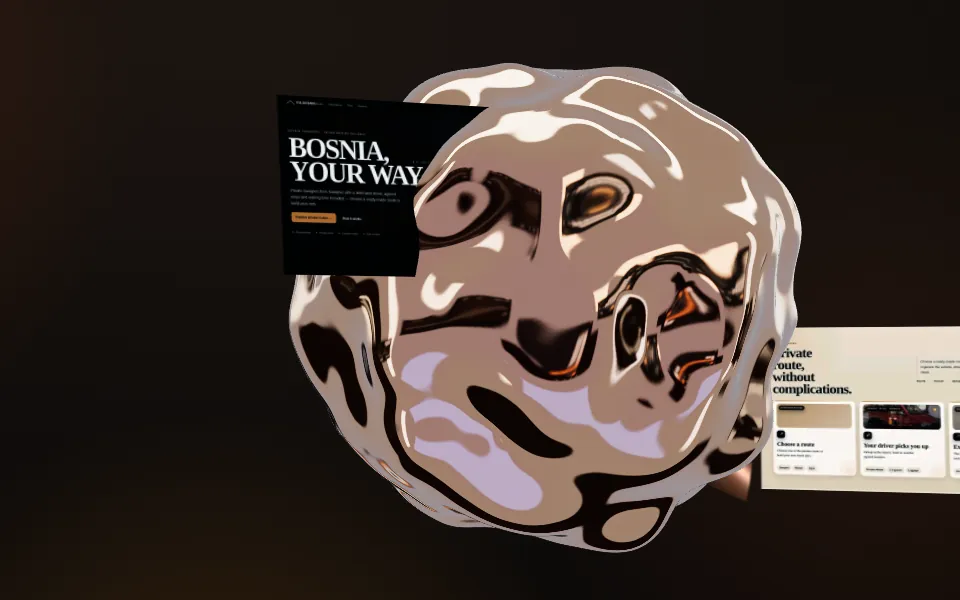
Your shapes and colours rendered as liquid metal, light or particles — motion that belongs to your brand instead of a stock effect.
Interactive, not just animated
Animation plays at the visitor. Interaction answers them. On a WebGL website the scene can react to the cursor or a finger, follow the scroll position exactly and open real content on click.
- Particles that move out of the way of the cursor.
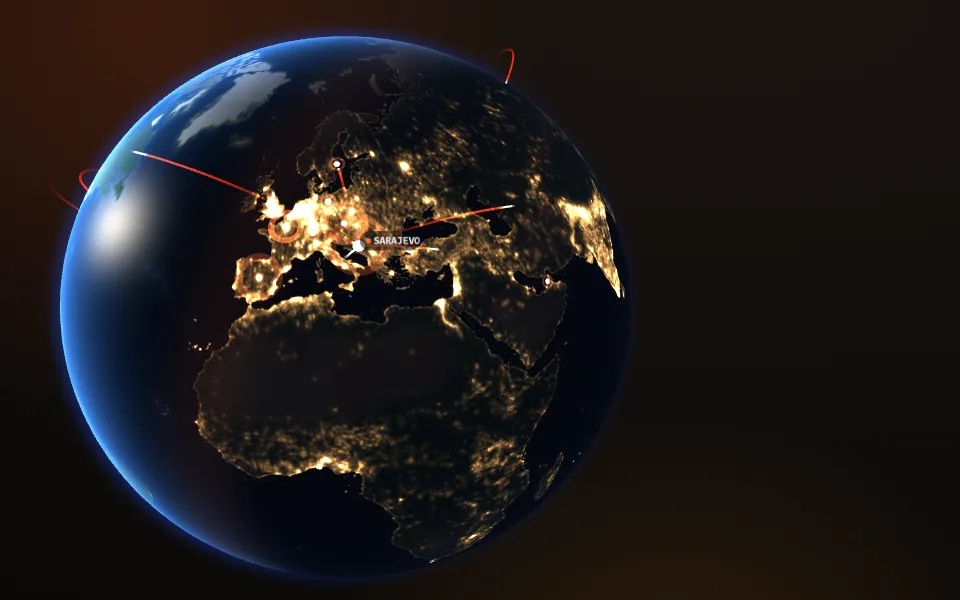
- A globe that follows the pointer, with arcs drawn from a real location.
- Project screens that open the live website when you click or tap them.
- Liquid chrome that ripples when a card melts into it.
Built so it still loads fast
The usual worry about a 3D website is speed and SEO. Both are part of the build from the first day, not something fixed at the end:
- All text stays in plain HTML. Search engines read every word, and the page still works with JavaScript switched off.
- Content first, 3D second. The text is visible immediately; heavier scenes prepare in the background.
- No stutter while scrolling. Shaders and textures are prepared ahead of time instead of the moment they appear.
- Adapts to the device. Resolution adjusts automatically when a device is slow, and phones get lighter versions of the same scenes.
- A fallback for every visitor. If a device cannot run WebGL, a clean static version is shown. The “reduce motion” setting is respected.
This website itself, measured with Google Lighthouse before launch: 100 for performance on desktop and 87–88 on mobile, and 100 for accessibility, best practices and SEO on both.
Who it is for
- Manufacturers and product brands that need to show how something is built or how it works.
- Construction, engineering and architecture firms with projects that deserve more than a photo grid — see websites for construction and engineering.
- Launches and campaigns — a landing page people remember and share.
- Creative studios and agencies that need a WebGL and Three.js developer for a client project, including white-label work under your name.
Real work
I only show what exists. Concepts are marked as concepts.
- This website — particles, liquid chrome, a 3D gallery and a real-time globe, built with Three.js. Scroll through it.
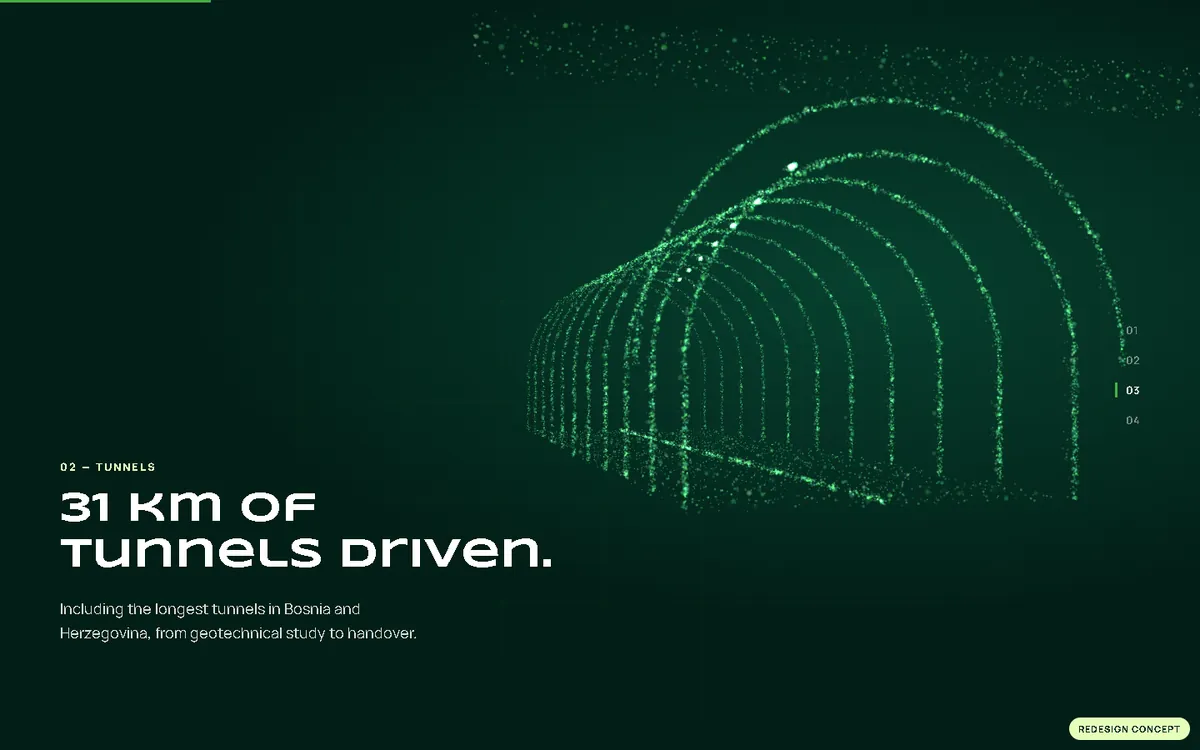
- PPG — redesign concept, not client work: an engineering company website with a particle tunnel and scroll scenes. Read about the concept.
- Class’Mat® — client project in Luxembourg: the multilingual website (French, German, English) you see on the 3D laptop at the top of this site. Read the case study.
Timeline, price and what is included
A first version in days, not months. A 3D or interactive website typically takes up to 7 days once your texts and images are ready; a landing page 2–4 days. Larger projects and online shops are planned together. These are estimates, not guarantees.
Price by agreement — you get a free estimate within 24 hours.
Included in every project:
- Custom design and hand-written code — no templates, no page builders.
- Built for phones first, tuned for speed.
- Basic SEO: clean HTML, titles and descriptions, sitemap, structured data.
- Several languages if you need them, each with its own address for Google.
- Help with domain and hosting.
- 30 days of fixes after launch.
You provide the texts and images — and product photos or 3D models, if you have them.
How it works
- 01
Conversation
What should the 3D do — explain a product, set a mood, guide a story? We agree on that before any code.
- 02
First scene
One scene is built first, so you can see and feel the motion early, on your own screen.
- 03
Build
The full site, with previews you can open on your own phone along the way.
- 04
Launch
Domain, hosting, speed and SEO checks — then it goes live, followed by 30 days of fixes.
Frequently asked questions
How long does a 3D website take?
Typically up to 7 days once your texts and images are ready, with a first version to review within a few days. A simpler landing page takes 2–4 days. Larger projects are planned together. These are estimates, not guarantees.
How much does a 3D website cost?
The price depends on the scenes and the number of pages, so it is agreed per project. Send a short description and you get a free estimate within 24 hours.
Will 3D make my website slow?
Not if it is built for speed from the start. The text loads first, the 3D prepares in the background, and the resolution adapts to the device. This site scores 100 for performance on desktop in Google Lighthouse.
Is a 3D website bad for SEO?
No. All text is in plain HTML that search engines read directly, with proper titles, descriptions and structured data. The 3D sits on top of the content; it never replaces it.
Does it work on phones?
Yes. Phones get lighter versions of the same scenes, layouts are designed for small screens first, and tapping works where desktop uses hover.
What happens on devices that cannot show 3D?
Visitors see a clean static version with all the content. If someone has “reduce motion” switched on, the ambient motion slows down.
Do I need 3D models?
No. Many effects — particles, liquid shapes, typography, abstract objects — are generated in code. If you already have 3D models of your products, tell me and we can look at using them.
Which technology do you use?
Three.js on top of WebGL, custom shaders and plain JavaScript, with no heavy framework. The result is standard HTML, CSS and JavaScript that runs on any good hosting.
Can I change the texts myself after launch?
The site is written by hand, not in a page builder, so text changes are made by me. Fixes are included for 30 days after launch; after that, changes are agreed as needed or covered by monthly maintenance.
How do we work together?
In English or Bosnian, by email and online video calls. In person in Sarajevo by arrangement. You get a reply within 24 hours.
More services
- Website designBusiness websites, landing pages and redesigns, coded by hand
- Construction & engineeringContractors, engineering firms, building materials, industry
- For agenciesWebsites and WebGL/3D built under your agency’s name
- Multilingual websitesEach language with its own address, titles and search presence
Contact
Let’s build something
people remember.
Tell me what you need. You get a reply within 24 hours with next steps and a quote made for your project.
Or write directly: hello@edweblab.com